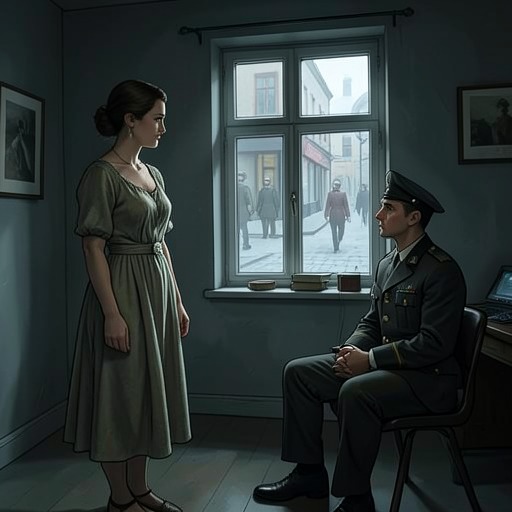
Paul Doll—Alisz Seisser
The Zone of InterestPaul Doll’s relationship with Alisz Seisser turns the language of protection into an instrument of control. Doll arranges comforts and claims responsibility for her safety, but he is also the camp commandant who exploits his power over a prisoner. Their intimacy, Alisz’s pregnancy, and Doll’s fear of exposure reveal how his professed guardianship serves both his desires and his need to preserve his authority.
Unequal Positions
Alisz is a Sinti prisoner and veterinary nurse at the camp piggery, a modest adjunct to the Home Farm Station. Her uniform resembles the marked clothing worn by helpers in the prisoners’ infirmary. Doll finds her in her surgery and presents his attention as concern for a woman in difficulty. She has recently been moved from the Women’s Block, which she describes as a place of utter despair, and believes Doll arranged the transfer. He assures her that he will continue to do what he can for her.
That assurance carries a meaning far beyond personal kindness. Alisz is confined within a system Doll commands; he can influence where she is held and what protection she receives. Her Sinti ancestry makes her especially vulnerable: Doll notes that she is, to his knowledge, the only Sinti prisoner in the Zone. He speaks as though her survival depends on his intervention, while the conditions that make his intervention valuable are part of the regime he serves. The imbalance is present from their first encounters, before their sexual relationship is disclosed.
Care as Invitation and Cover
Doll encourages Alisz to trust him through the ordinary particulars of care. He asks whether she has blankets and receives the ration associated with her veterinary work, and promises to continue helping her. He invokes the memory of her dead husband, Orbart, as a fallen comrade who gave his life for his convictions. Yet the account sets this tribute against Doll’s private appraisal of Alisz’s body, exposing the gap between the respectful language he performs and the sexual interest it conceals.
He then tells her that Hannah Doll wants her to visit the villa. The invitation is given a convenient explanation: the family pony has mange, and Alisz can come under the pretext of looking after it. Doll adds that Hannah has women’s things to give her, promises to collect her by car, and advertises steak, potatoes, greens, and a long hot bath. These promised comforts are concrete and appealing, especially to a prisoner, but they also help make the invitation difficult to refuse on equal terms. Doll controls the journey and the setting, while presenting the visit as a favor arranged by his household.
His later account confirms that he has arranged for Alisz to be transferred to a facility in the basement of the MAB. Once there, he visits after his work, sometimes well past midnight, bringing a small snack such as a prune or a cube of cheese. He describes their conversations as a shared recollection of youth and the German countryside: Alisz tells stories of summer on the Pomeranian coast, while Doll talks about the Haardt Forest and his horse, Jonti. The small gifts and conversational intimacy make the arrangement seem domestic, but its setting remains a place of confinement, and the transfer itself is something Doll says he engineered.
The Guardian’s Contradiction
Doll tells Alisz that she is safe in the basement, at least until the period of intense selections passes. He admits that he cannot be everywhere, implicitly acknowledging that the danger is not imaginary and that his power to protect her has limits. Alisz responds with trust. Doll, for his part, insists that there is no question of impropriety: he casts himself as the respectful guardian of a comrade’s widow and calls Alisz his charge or protégée. That self-description is incompatible with the sexual relationship the narrative later makes explicit. His version of care does not undo the coercion; it allows him to describe his control as benevolence.
The contradiction becomes unmistakable when Alisz is pregnant. Doll identifies the news as a serious disappointment and immediately measures its implications against his own position. Fraternizing with a prisoner is already dangerous for him, he says, while a sexual relationship across the regime’s racial categories could end his career. His first expressed fear is thus professional ruin. He also threatens Alisz with the fact that his word would be set against hers and calls attention to her official status as a person the regime treats as less than human. The man who has presented himself as her protector now reminds her that the system gives him the greater power to define what happened.
Alisz counters that the danger to her is not merely a matter of Doll’s reputation. If she gives birth in the facility, she may be killed. She also points out the obvious difficulty in his implied denial: during the period of her confinement, the custodial staff consists of two female guards and a very old male guard. Her words force the risk he has framed as a threat to his career back into the life-or-death terms she faces. Doll responds that he will think of something, then tells her to stop when she is crying and reminds her that she is pregnant. His brief gesture of concern does not resolve the peril or provide a recorded outcome for the pregnancy; it leaves the imbalance between his promise and her danger intact.
Self-Justification and the Marriage
Doll’s account of the affair is also entangled with his self-image as a sexually normal and virile man. He cites his two Iron Crosses as proof of his masculinity and insists that his libido requires no boast because he is entirely normal. Elsewhere, he describes his marriage to Hannah Doll as sexually unfulfilled, attributes her frigidity to her earlier relationship with Dieter Kruger, and imagines that his patience and gentleness might change her response. These claims help explain the story he tells himself about Alisz: desire becomes not an abuse of authority but an answer to deprivation, a means of restoring his sense of masculine normality.
He later says that his encounters with Alisz are necessary to maintain his dignity and self-respect, and sets her esteem and sexual pleasure against the appalling atmosphere of life at the Doll villa. At the same time, he confesses fear of Hannah, whose appearance and manner he has come to read as a threat. This account does not establish Alisz’s independent view of the relationship beyond the trust and gratitude she expresses in the recorded encounters. Instead, it shows how thoroughly Doll narrates the arrangement through his own needs: his marriage, his dignity, his safety, his career. The contrast between his claim to be Alisz’s guardian and his use of her as refuge from domestic dissatisfaction makes the relationship a concentrated portrait of authority disguising exploitation as care.